What Household Label Work Usually Demands
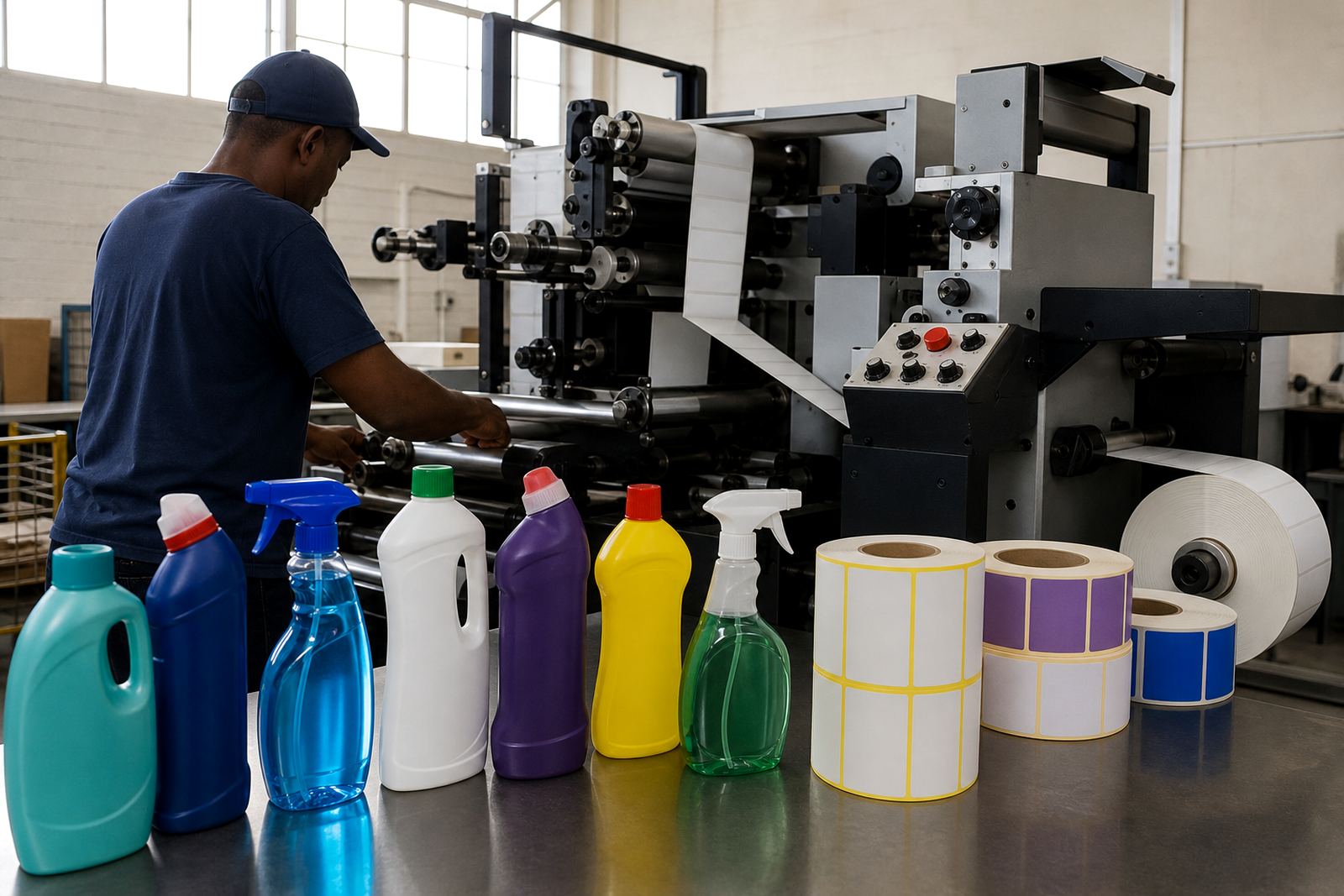
Household goods cover a wide range of products, from dishwashing liquids and bathroom cleaners to polish, air fresheners and laundry care. The label often has to carry ingredient details, safety notes, barcodes, batch codes and barcodes again on smaller packs, so readability matters just as much as appearance. In many cases the label must cope with damp hands, condensation, splashes, cold storage, moving cartons and repeated handling in shops or during delivery. A clear label also helps with municipal and retail compliance, especially when the pack is sold across several provinces.
For this type of work, narrow-web flexo label presses are a practical fit because they handle repeat work well and can support a mix of substrates and finishing steps. The press room usually needs to manage more than one label size, with short changeovers and steady register. If your customers in Johannesburg, Durban or Cape Town need regular replenishment, the biggest pressure is often not just print quality but keeping the line moving without extra waste.
Typical Press and Finishing Setups for Home Care Labels
A household label line often starts with a narrow-web flexo press, then adds the setup needed for die cutting, stripping, slitting and rewinding. Depending on the product range, converters may also need finishing for varnish, lamination or overprint areas that protect the label from moisture and scuffing. We help with press installation and commissioning so the layout supports the job mix, not only the first run.
For a factory in Kempton Park or an operation serving the East Rand and Pretoria, space planning matters. A press may need room for rolls in, rolls out, inspection, waste handling and access for maintenance. In humid coastal areas like Durban and Gqeberha, material storage and drying conditions deserve extra attention, because adhesive and substrate behaviour can shift with the weather.
- Narrow-web flexo press for repeat label production
- Finishing line for cutting, slitting, rewinding and inspection
- Plate mounting support for cleaner register and fewer setup delays
- Anilox care to help maintain ink laydown and consistency
- Startup production support for the first runs after installation
Planning Your Line Around Day to Day Household Orders
Household label work is often a mix of standard repeat jobs and urgent reprints. One week may focus on 500 ml cleaner bottles, then the next on larger refill packs or seasonal promotions. That means your workflow has to allow for quick job changes, sensible material storage and a finishing section that does not become the bottleneck. If the line is too tightly arranged, the operator spends too much time walking between stations, checking rolls or moving waste.
We usually advise converters to map the whole path before buying or moving equipment: incoming material, printing, drying, inspection, finishing, packing and dispatch. In many South African factories load-shedding also needs to be part of the plan. Backup power, safe shutdown steps and restart procedures can make the difference between a normal shift and lost stock. For smaller teams, operator training and production consulting are often as important as the machine itself.
- Keep frequently used materials close to the press
- Allow space for finished rolls, rejects and rework
- Plan for power interruptions and safe restart steps
- Store labels and substrates away from heat and damp
- Build in room for inspection and batch traceability
Common Mistakes on Household Label Jobs
A common mistake is choosing a finish that looks good but does not suit the pack. High gloss can be fine on some retail products, but on a bottle that gets handled often it may still mark up if the wrong overprint or laminate is used. Another issue is crowding too much text into a small label. Household products often need legal copy, usage directions and warnings, and if the layout is squeezed the result is hard to read on shelf.
Other problems come from poor setup discipline. Weak plate mounting, dirty anilox cylinders, inconsistent tension or rushed colour matching can lead to waste and missed delivery dates. We also see jobs where the label size was not checked against the bottle shoulder or curve, so the artwork looks fine on screen but fails on the pack. Small errors become costly when you are printing for multiple distribution centres and need a clean reprint fast.
Budget Ranges for Household Label Production Equipment
Budget depends on the press width, age, condition, level of automation and the amount of finishing included. For household labels, many converters start by budgeting for the press itself, then add installation, commissioning, operator training and spare parts support. It is also worth budgeting for maintenance from the beginning, because a press that is not kept clean and aligned will cost more later in waste and downtime.
As a practical guide, small to mid-sized narrow-web flexo label projects in South Africa can range from entry-level setups at the lower end of the market through to higher-value lines with more finishing and control features. Once you add installation, startup production support and preventive maintenance, the total spend changes quickly. We prefer to discuss the actual job mix first, then shape the budget around what the converter needs for domestic supply and not just the first month of production.
- Press supply and installation planning
- Commissioning and operator handover
- Finishing setup and workflow layout
- Preventive maintenance and breakdown support
- Remote support for ongoing production issues
Support Across Gauteng and the Main Coastal Routes
Our base is in Spartan, Kempton Park, with support for label converters in Johannesburg, Pretoria, Durban, Cape Town and Gqeberha. That matters when a household label line is under pressure and a customer wants a quick turnaround on a cleaner or detergent range. We work with production teams who need practical help, not long delays, whether the issue is setup, plate mounting, finishing or spare parts support.
Thabo Mokoena leads the business, with Aisha Patel on sales, Johan van der Merwe on technical matters, Lerato Ndlovu on training, Sibusiso Khumalo on service and Megan Naidoo on customer support. Clients reach us through the enquiry form on our contact page, and from there we can assess the job, the pressroom setup and the support needed. For household labels, the aim is simple: clear printing, dependable finishing and a line that keeps up with the work.